This review contains minor spoilers for ‘The Uncanny X-Men‘ #20

Gail Simone brings The Uncanny X-Men back this week with a revealing issue centered on Valentin Correa. Like the other Outliers, his past remains largely a mystery, and issue #20 begins to unravel that thread, piece by piece.
The story opens in an unexpected setting: Graymalkin Prison. We reconnect with Dr. Ellis as she initiates a conversation with Monet St. Croix, one of the inmates briefly seen back in issue #9. Ellis tries to manipulate her way into a friendship, but Monet—ever the sharpest mind in the room—quickly sees through the act and shuts it down. Her reveal that she’s known about Ellis and her family for some time, followed by her dramatic breaking of the inhibitor collar, stands out as one of the issue’s best moments.
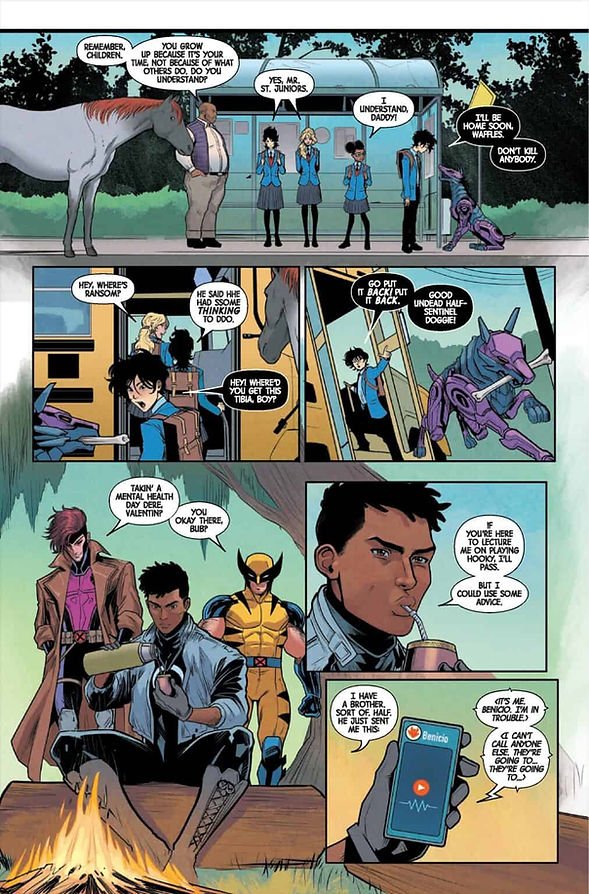
From there, the focus shifts back to the Uncanny X-Men, zooming in on Valentin as he receives a troubling call from his half-brother. In a dramatic scene with Wolverine and Gambit, they discuss the burdens of family. The visuals here deserve praise—Benicio’s fight is beautifully illustrated in the background panels, unfolding as the dialogue plays out in the foreground. Eventually, Logan persuades Valentin to check on his brother, sending them both to Argentina.
Their search for the Word of Strength cult, who Benicio is involved with, leads them to a bar where a brutal fight erupts. During the brawl, Valentin reflects on his emotional struggles, hinting at depression. The dramatic activation of his mutant powers is also revealed, in a memory of Valentin being shot as a young boy as a result of his parents not paying his kidnapper’s ransom. This moment lands with emotional weight, enhanced by Vecchio and Wilson’s dynamic artwork paralleling the internal and external conflicts.
The issue closes with the surprise introduction of Valentin’s father, teasing a potential team-up in the next chapter. Overall, this was a strong, character-driven entry that digs into one of the more intriguing Outliers. Hopefully, issue #21 continues to explore Valentin’s complexity and the depth he clearly has to offer.